
Please note that this website is run on a non-profit basis for educational and research purposes. Images are credited with their respective copyright holders where they are known. You may not copy any image for commercial purposes. Please do not ask me for permission to use any images – that permission is not mine to give. If you are the copyright holder for an image and wish it to be removed, please contact me via the form at the foot of the page and I will of course be happy to do so. Also, if you are the owner of an uncredited image and wish to be named, again please contact me and I’ll happily add that information.

image thanks to Architectural Review

The 1982 ITV franchise renewal also saw the creation of a new ‘breakfast’ category. After a very hotly contested competition, TV-am won. When they were setting the company up, at one point they considered using Ewarts Studios in Wandsworth but in the end they constructed a studio centre in Hawley Crescent, Camden unimaginatively called the Breakfast Television Centre which quickly became known as ‘Eggcup House’ due to the rather eccentric architectural adornments along its roofline. Terry Farrell, who would shortly go on to carry out a similar job adapting a warehouse in Docklands into Limehouse Studios, converted the building at a cost of £7m from a 1930s Henley’s garage.

with thanks to www.tv-am.org.uk

with thanks to www.tv-am.org.uk

The building itself was arguably London’s first post-modern design. Its exterior was completely transformed from the original garage and the interior too was highly distinctive.
The centre had three studios; A was 60 x 50 metric feet within firelanes and B was 34 x 22 metric feet. There was also a small presentation studio – C – which was about 16ft x 12ft. The studios were originally equipped with Marconi Mk IXB cameras. Studio A contained the main set with its famous sofa and B was used mostly for news. However, there was also enough space in A to house Timmy Mallett’s Wide Awake Club (’84-’89) and Wackaday (’85-’92)


with thanks to www.tv-am.org.uk
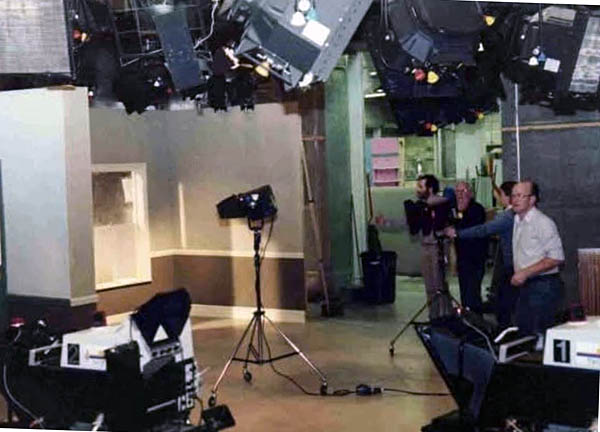
Directly behind me was the main sofa set (in fact I think I’m standing on the plinth where the sofa was as the position looks elevated)
The World of Melanie Parker set wasn’t permanent. All flats which could be were struck to reveal a cyc area. You can see the weights and braces.
If you look above the guys you can just see the scene dock doors and scene dock itself.’
photo taken by John Andrew in 1983
A very short history of what became the most successful breakfast TV company in the world…
TV-am began as a news-based service and had several well-known presenters of the day who fronted it. However, the BBC decided they had to offer a show too so they began broadcasting Breakfast Time from Lime Grove on 17th January 1983. TV-am did not begin until a fortnight later, on 1st February. Unfortunately for them the BBC show, fronted by Frank Bough and Selina Scott, proved much more popular and TV-am entered a crisis. The public did not just want news with their breakfast but something a little lighter too. The high profile presenters who had started the company all left and were replaced with Anne Diamond, Nick Owen and famously Roland Rat. Audiences began to recover but the company was still making a loss.
In 1984, Bruce Gyngell – an Australian with a no nonsense approach to business – took over as chief executive following the early period of deepening financial crisis. His approach included reducing technical crews to a minimum in order to save costs. This put him at odds with the unions and a 24 hour strike was called. The management locked out the strikers – who were never to return. After a long period of waiting on the picket lines they were sacked.
The Marconi cameras mentioned above proved vital in the fortunes or otherwise of the company. The Mk IX was very advanced and had an automatic line-up procedure. This meant that only a very basic technical knowledge was required to enable the camera to produce acceptable pictures. Without this facility it is doubtful that the studio could have continued for more than a few days with nobody in the building able to carry out a full camera line-up. Secretaries operated the cameras and later, non-union cameramen were brought in – most from overseas.
The shambolic results proved popular at first for all the wrong reasons but the viewers stayed and increasing advertising revenue turned the fortunes of the company around. By doing away with many technical staff and traditional working practices, TV-am became the most profitable television company in the world in turns of turnover. Bruce Gyngell became a great friend of Margaret Thatcher – which made the result of the franchise renewal all the more ironic.
The next twist in tail of the history of ITV came at the end of 1992. Under a new ‘sealed bids’ round of franchise renewals introduced by Margaret Thatcher, Thames unexpectedly lost its bid along with the by now highly successful TV-am. Conspiracy theorists say that the government wished revenge on Thames for screening the documentary Death on the Rock. We may never know whether there is any truth in this rumour. However, there is little doubt that Mrs Thatcher was horrified at the loss of TV-am, a company that operated in all the ways she held dear so it is hard to believe that the whole franchise renewal process was fixed.

When GMTV took over the franchise in January 1993 they decided to use studio 5 at LWT’s base on the south bank. ‘Eggcup House’ was therefore left empty but shortly afterwards it was bought by MTV. The main studio was initially used for MTV’s output but later other companies booked it too. For example, the sketches for the 2004 series of The Frank Skinner Show were recorded here and during 2005 the Saturday morning show Top of the Pops Reloaded was based in studio A. Other shows made for various channels included UK Music Hall of Fame, Britain’s Best Home, Ruby, Classic Comeback and The Joan Rivers Position. In March and April 2007 the BBC’s Castaway Exposed series was also based here and Five’s kids’ series Milkshake was booked for a second series.
Although these studios were busy during the 1990s, the next decade saw rather less activity. MTV no longer used them to make shows for themselves – their channels no longer including studio based programmes or live performances. They were still hired out to various production companies but rumours of the imminent closure of the studios began to circulate around the industry in 2007/2008. However, with Capital Studios closing in the summer of 2008, they began to pick up some of the work that might have gone there. For example, The BBC’s Missing Live came from MTV in the spring of 2009 and 2010 and Crimewatch Roadshow was also made here. Angela and Friends – daytime magazine programme for Sky 1 – was based here from November 2009.
Unfortunately, MTV’s management decided that the studios were not part of their core business and it made more sense financially to close their offices in Oxford Street and Rathbone Place and bring the 300 staff here. The building was redeveloped and the studios were turned into offices. The last programme made here was at the end of January 2011.
In May 2014 Viacom bought Channel 5 and decided to move its staff to this building. A new 4-storey block rather grandly called ‘The Tower’ was built. They also took over adjacent buildings The Lock and the former brewery Elephant House. The latter then housed Channel 5 Productions and was renamed Elephant House Studios. In the autumn of 2016 a small studio was created here for Channel 5’s long-running kids’ show Milkshake.
One consequence of MTV’s studios perhaps not appreciated by many was their indirect effect in the area of TV lighting. The contract to provide lighting equipment, lighting directors and console operators went to a small business called Aurora Lighting. Several LDs and console ops cut their teeth on the various shows that passed through these studios – not only music but a wide variety of programmes. Once the studios closed, these individuals became freelancers and progressed to work on many well-known music and entertainment shows.
1 Leicester Square…
MTV built this small studio on the first floor of a building in Leicester Square with windows overlooking the square. The studio and its facilities were converted from a nightclub and opened after a planning appeal in the summer of 2004. The reason for opening the studio was because the very popular US version of the channel had a studio overlooking Times Square so it was felt that the UK should have something similar. The studio was only 450 sq ft – the main floor being just over 37ft long but only about 6ft 6in wide (!) and with a mezzanine 56 x 14ft.
1 Leicester Square was originally used for MTV’s Total Request Live show which included performances by live bands. Despite all the effort in getting the studio built for the show, TRL proved not to be a great success in the UK and the show folded in December 2005. From September 2006 to March 2007 the studio became the base for the BBC’s Saturday morning kids’ show TMi. However, the cost of keeping the studio open with so little use led to its being disposed of later in 2007. (The following series of TMi was made in TC9 at TV Centre.)